



SAPPE places strong emphasis on conducting its business sustainably, with the belief that good corporate governance is a fundamental foundation for building transparency, accountability, and trust among all stakeholders, including investors, suppliers, business partners, employees, and consumers. Guided by this principle, the Company is committed to continuously enhancing its management systems to ensure efficiency, transparency, and accountability. The Board of Directors, as the leadership body of the organisation, plays a key role in overseeing and driving operations in accordance with good corporate governance principles, while establishing governance policies to further strengthen systematic practices and clear standards across the organisation.

To ensure the effective implementation of these principles, the Company promotes adoption across all levels of the organisation,
fostering understanding and embedding a culture of good corporate governance on a continuous basis.
The Company’s corporate governance policy is structured around 5 key principles, which serve as the foundation for the continuous enhancement of its governance practices and long-term sustainable business performance.
The Rights of
Shareholders
The Equitable Treatment of Shareholders
The Role of
Stakeholders
Disclosure and Transparency
Responsibilities of the Board
of Directors
Good Corporate Governance Targets
– Maintain a 5-star Corporate Governance Score (CG Score), as assessed by the Thai Institute of Directors (IOD).
– Promote Board diversity by maintaining a minimum of 30% female representation on the Board of Directors by 2026.
– Achieve zero material incidents of non-compliance with applicable laws and regulations.
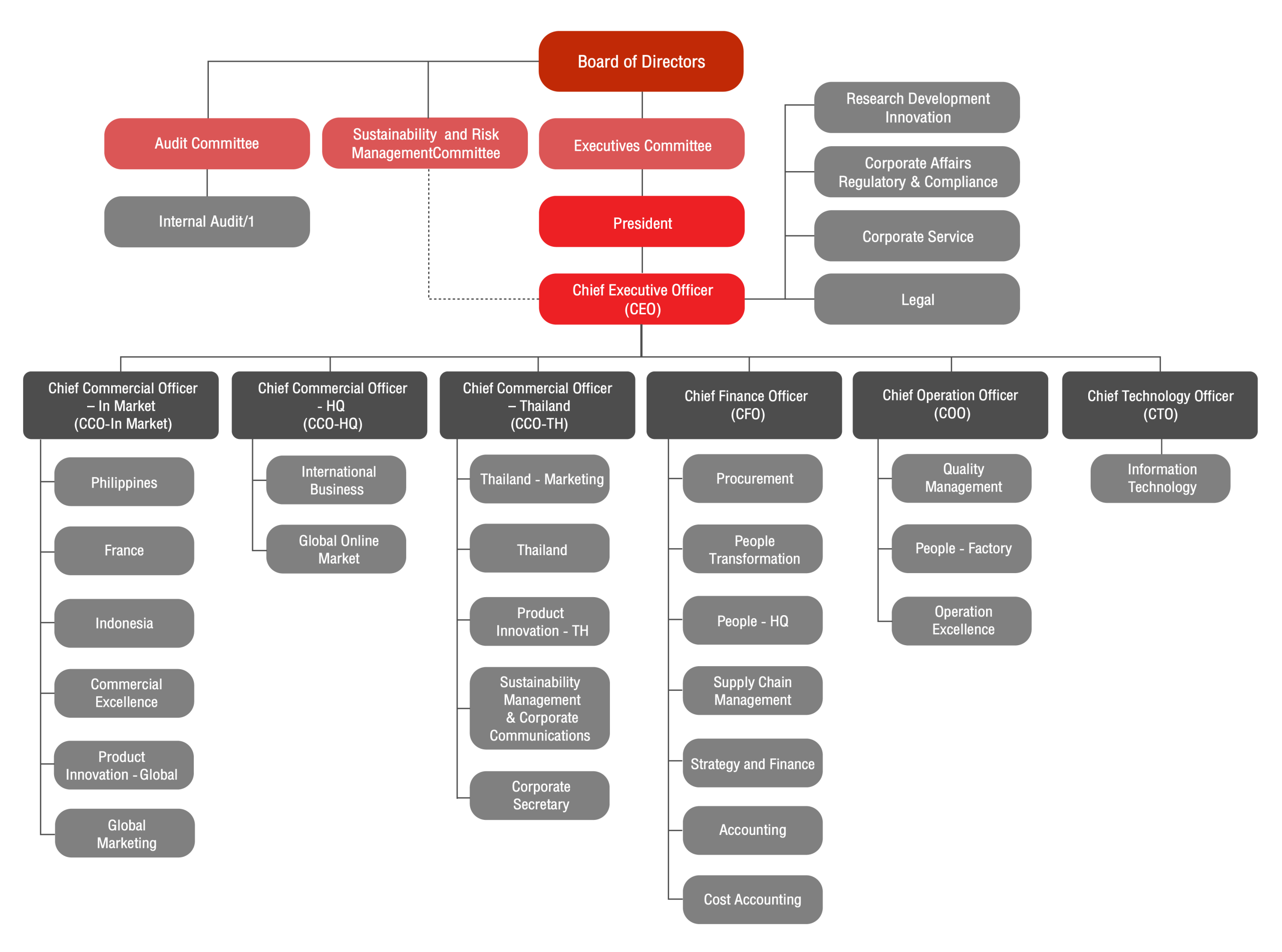
Corporate Governance Structure
The Company has established a clear and transparent corporate governance structure aligned with good governance principles. The Board of Directors is responsible for setting the Company’s strategic direction, policies, and overall oversight to ensure effective management, while taking into consideration the interests of all stakeholder groups.
To support the effective discharge of the Board’s responsibilities, the Company has established dedicated Board committees, including the Audit Committee, the Sustainability Development and Risk Management Committee, and the Executive Committee. These committees are responsible for reviewing, providing oversight, and making recommendations on specific matters within their respective areas of responsibility, thereby strengthening the overall effectiveness of the Company’s corporate governance framework.
Board
Member Composition
Executive directors accounted
for 40%
of the Board
Progress Bar
0%
Non-executive directors accounted
for 60%
of the Board
Progress Bar
0%
Independent directors accounted
for 50%
of the Board
Progress Bar
0%
Non-executive, non-independent directors accounted
for 10%
of the Board
Progress Bar
0%
Female directors accounted
for 30%
of the Board
Progress Bar
0%