

SAPPE operates a single manufacturing facility located at 8 Moo 7, Phuet Udom Subdistrict, Lam Luk Ka District, Pathum Thani, an area identified as a water-stressed area. Recognizing water as a finite and critical natural resource, the Company is committed to responsible water stewardship and continuous water management to minimize environmental impacts. The Company conducts comprehensive water use assessments to identify opportunities for improving water efficiency and has established a dedicated water management team responsible for overseeing water resource management. This includes enhancing production efficiency and upgrading equipment and technologies to reduce overall water consumption.
In addition, SAPPE places strong emphasis on wastewater quality improvement through continuous monitoring and control of key parameters, including Chemical Oxygen Demand (COD), Biochemical Oxygen Demand (BOD), Suspended Solids (SS), and pH, to ensure compliance with the standards established by the Department of Industrial Works.The Company also maintains a Zero Discharge policy, ensuring that no wastewater is discharged outside the facility, thereby minimizing potential impacts on the environment and surrounding communities.

Sustainable Water Management Targets
– Operate under a Zero Discharge policy, with no wastewater discharged outside the Company’s facilities.
– Reduce water consumption per unit of production by 10% from the 2025 baseline by 2027
– Limit water withdrawal from external sources in water-stressed areas to no more than 60%
Factory Water Usage and Wastewater Discharge
| Water Volume (Cubic Meters) | 2025 | 2024 | 2023 |
|---|---|---|---|
Water Withdrawal |
600,050.1 |
707,292 |
576,722 |
|
– Surface water from rivers, lakes, natural ponds |
600,049 |
707,289 |
576,711 |
|
– Groundwater from wells, boreholes |
0 |
0 |
0 |
|
– Used quarry water collected in the quarry |
0 |
0 |
0 |
|
– Municipal potable water |
1.1 |
3 |
11 |
|
– External wastewater |
0 |
0 |
0 |
|
– Harvested rainwater |
0 |
0 |
0 |
|
– Sea water, water extracted from the sea or the ocean |
0 |
0 |
0 |
|
Total Water Consumption |
1,204,027 |
1,119,897 |
845,286 |
|
Water Usage Ratio (Inflow-Outflow) (%) |
50 |
63 |
68 |
Beverage Production Water Intensity (m3/litre) |
0.0046 |
0.0041 |
0.0035 |
Total Wastewater Discharge |
0 |
0 |
0 |
– Ocean |
0 |
0 |
0 |
|
– Surface water |
0 |
0 |
0 |
|
– Subsurface / well |
0 |
0 |
0 |
|
– Off-site water treatment |
0 |
0 |
0 |
|
– Beneficial / other use |
0 |
0 |
0 |
To achieve its established targets, SAPPE has implemented a water management approach at its manufacturing site by recycling water generated from production processes and maximizing water reuse to reduce dependence on external water sources. This water management practice has been implemented at SAPPE’s sole manufacturing facility, representing 100% of the Company’s total production sites.
Water Recycling and Reuse
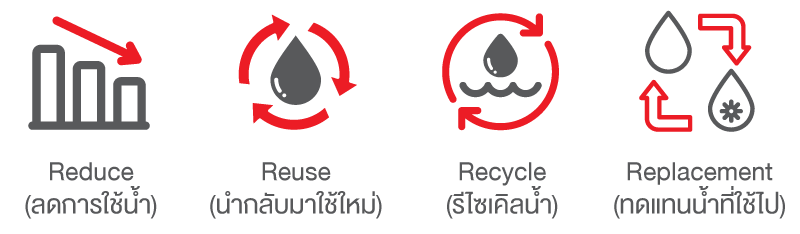
The Company has continuously initiated and implemented water conservation projects through the collaborative efforts of all manufacturing facilities. These initiatives can be categorized into four key groups, in line with the 4Rs water management approach, as follows:
Water Recycling and Reuse
0
Cubic meter (m³)
No Data Found
No Data Found
Soluris